

 Photo: Kampus Production / Pexels
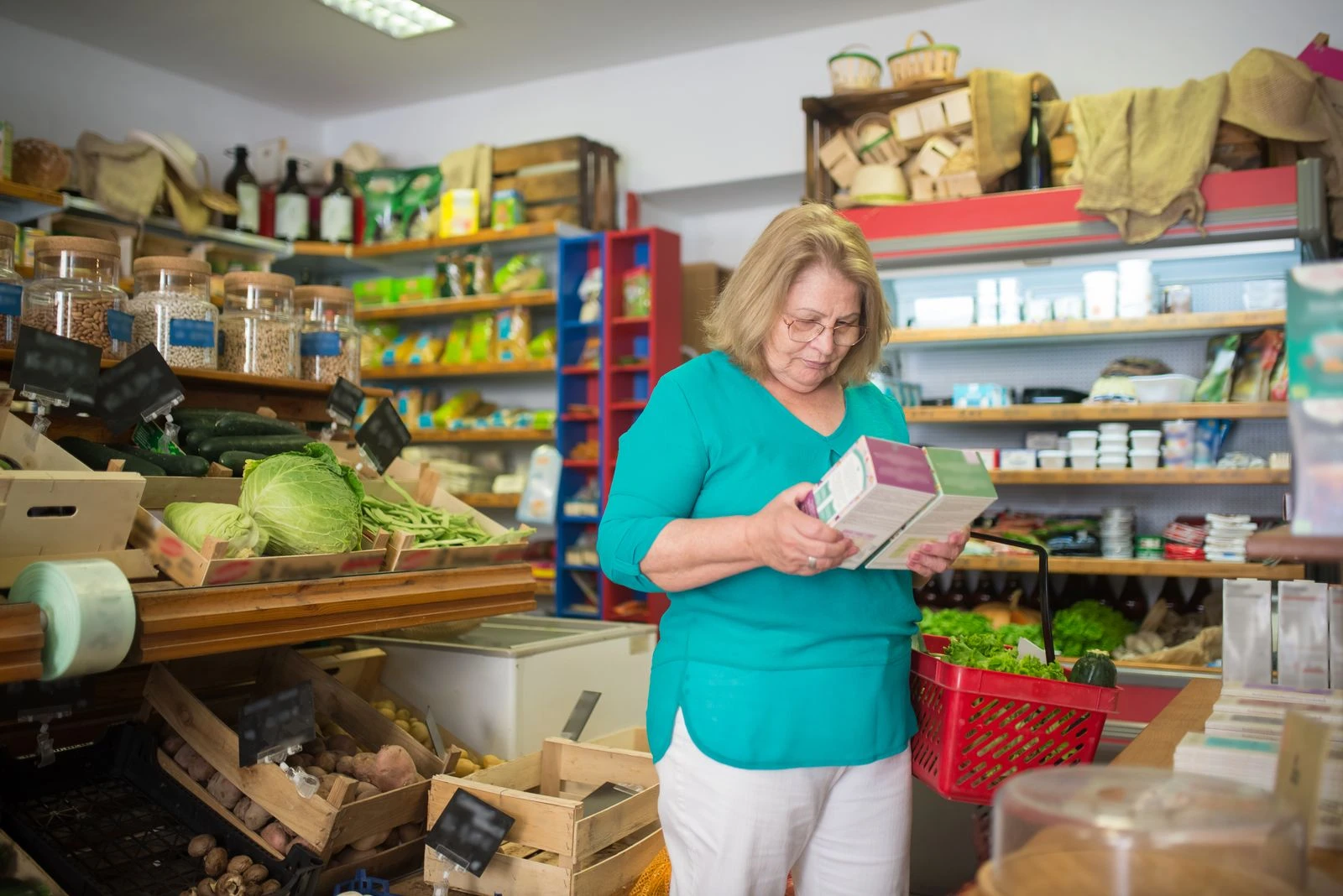
Almost everything you need to know for keto is printed on the back of the pack. Why the "Carbohydrate" line on European products already excludes fibre is covered in the guide How many carbs a day on keto. What confuses people most are the lines that only some labels carry and the claims splashed across the front of the packet.
Contents
What the label must show
In the EU the nutrition declaration has seven compulsory lines, always given per 100 g or 100 ml: energy, fat, saturates, carbohydrate, sugars, protein and salt. Fibre and polyols are up to the manufacturer, so you will find them on some labels and not on others.
Label line | What it means on keto |
|---|---|
Carbohydrate | the figure that matters; it includes sugars, starch and polyols |
of which sugars | only monosaccharides and disaccharides; a low figure here does not mean few carbs |
Polyols (if listed) | sweeteners such as maltitol or erythritol; they are already inside the carbohydrate figure and you subtract them to get net carbs |
Fibre (if listed) | already outside the carbohydrate figure, so do not subtract it again |
Polyols
The EU labelling regulation includes polyols in the carbohydrate figure, though it does not treat them all alike. When it works out the energy, a gram of erythritol counts as 0 kcal, other polyols as 2.4 and the rest of the carbohydrate as 4.
On this site we get net carbs for a European product by taking the polyols away from the label's carbohydrate. That is why erythritol in our database shows 100 g of carbohydrate per 100 g, all of it polyol, and 0 g net. Only subtract when the label gives polyols a line of their own; if it does not, keep the carbohydrate figure as it stands, even when a sweetener appears in the ingredients.
Claims on the front of the pack
What a product may say about sugar is governed by a separate EU regulation, whose rules also cover any wording likely to mean the same thing to a shopper. The "sugar-free" you see on the shelf therefore has to meet the same limits as "sugars-free".
Claim | What it means |
|---|---|
"Sugars-free" | no more than 0.5 g of sugars per 100 g or 100 ml |
"Low sugars" | no more than 5 g of sugars per 100 g (2.5 g per 100 ml for drinks) |
"With no added sugars" | no sugar or other food added for its sweetness; if the product has sugars of its own, the label also says "contains naturally occurring sugars" |
"Reduced …" or "light" | at least 30% less of the named nutrient than a similar product |
None of them says a word about starch. The petit beurre with no added sugar in our database has just 1.2 g of sugars yet 67 g of net carbs per 100 g, since it is made with flour. Thirty grams of it come to 20 g, which is the whole daily allowance on strict keto.
The order of ingredients
Ingredients are listed by weight, starting with whatever went into the product in the largest amount. If flour, sugar or starch comes first, you know what you are holding before you even get to the numbers.
Watch out for maltodextrin too. Under the regulation it is not a "sugar", being neither a monosaccharide nor a disaccharide, but it counts in full as carbohydrate.
Per 100 g or per portion
The per-100 g figure is compulsory, and it is the one that lets you compare two products. Many labels add per-portion figures as well, but the manufacturer decides what a portion is, so check how many grams that is and how much you will really eat.
The sum is simple: grams you eat × carbs per 100 g ÷ 100. Fage 2% strained yogurt has 4.5 g per 100 g, so a 200 g bowl gives 9 g. If you would rather skip the arithmetic, the net carbs converter will do it for you.
Sources
- Regulation (EU) No 1169/2011, consolidated text — the definitions of "carbohydrate", "sugars" and "polyols" (Annex I), the compulsory nutrition declaration (Article 30), expression per 100 g (Article 32), the order of ingredients (Article 18), the conversion factors (Annex XIV: carbohydrate 4, polyols 2.4, erythritol 0 kcal/g).
- Regulation (EC) No 1924/2006, consolidated text — Annex: the claims "sugars-free", "low sugars", "with no added sugars", "reduced" and "light/lite".
- Food database — petit beurre with no added sugar (67 g carbohydrate, 1.2 g sugars) and erythritol (100 g polyols, 0 g net).
About the author
The Ola Keto team
Texts signed “The Ola Keto team” are written and edited by the people who build the site.
Comments
Comments are members’ personal views and experiences and are not medical advice. Do not change medication or treatment without your doctor.
To comment, sign in or create an account.
No comments yet. Write the first one.