

 Photo: william wallace / Unsplash
BEFORE YOU READ
The content is informational and does not replace medical advice. Read the full medical disclaimer.
The keto diet cuts out almost all carbohydrates: bread, pasta, rice, potatoes, sugar and most fruit come off the plate. In their place go fat and a moderate amount of protein, which in practice means meat, fish, eggs, cheese, olive oil and plenty of vegetables.
If carbs stay very low for a few days, the body switches fuel and starts relying on fat; the whole diet rests on that switch. Most people take it up to lose weight or to get their blood sugar under better control, but medicine has known it for about a century: since the 1920s it has been used for epilepsy that does not respond to medication.
Figures for foods come from Ola Keto’s food database and always refer to 100 grams.
Contents
What ketosis is
Your body runs mainly on glucose, which it gets from carbohydrates (the brain alone needs around 120 grams a day). Once carbs are cut, it first uses up the glucose it has stored in the liver and muscles.
Within three to four days those stores run out and insulin drops. From then on the liver makes ketone bodies (simply “ketones”) out of fat, and the brain, the muscles and the heart run on them. This state is called ketosis.
It is nothing strange to the body. We all slip into mild ketosis at night while we sleep, or after very hard exercise. On the diet some people get there quickly, others take a little longer.
Ketosis is not ketoacidosis
The two words sound alike, but the states have nothing in common. In diet-induced ketosis ketones rise a little and the blood keeps its normal pH. Ketoacidosis is a medical emergency, with ketones very high and the blood turning acidic.
It mainly affects people with diabetes, which is why anyone with diabetes should start keto only together with their doctor (more on this further down).
How many carbs you eat
There is no “official” keto. Most versions keep carbs below 50 grams a day and the strictest go down to 20.
To give you an idea, a medium banana without the peel has about 25 grams, as much as two slices of toast bread, whereas a large plate of spinach comes to no more than 3.
Net carbs
On keto we count net carbs, meaning the carbs your body actually absorbs. Fibre is not digested or absorbed in the small intestine, so it stays out of the count.
Labels need a little care. On food sold in the European Union the “Carbohydrate” line does not include fibre (it has a line of its own), so the number on the pack is already net carbs. On American labels fibre is part of the total and you subtract it yourself; worth remembering when you read recipes from the US.
“Sugar-free” products deserve a second look, because polyols (sweeteners such as maltitol or erythritol) are counted in the label’s carbohydrate like any other carbohydrate. For your own sums there is the Net carbs converter.
Protein and fat
Protein stays moderate, just enough to keep your muscles. If you eat much more, the liver turns some of it into glucose and ketosis becomes harder.
Most of the calories come from fat. Greek cooking starts with an advantage here: olive oil, olives, nuts, oily fish and avocado are all low in saturates, which has a bearing on cholesterol. For a first idea of your own amounts, try the Macro calculator.
What you eat on keto
Keto rests on meat, fish, eggs, cheese and non-starchy vegetables, with olive oil at the centre.
Group | Food | Net carbs (g per 100 g) |
|---|---|---|
Vegetables | 1.4 | |
Vegetables | 1.7 | |
Vegetables | 2.9 | |
Vegetables | 4.0 | |
Meat | 0 | |
Fish | 0 | |
Fish | 0 | |
Eggs | 0.7 | |
Cheese | 3.9 | |
Yogurt | 2.9 | |
Fats | 0 | |
Fats | 1.8 | |
Nuts | 5.7 | |
Fruit | 4.3 |
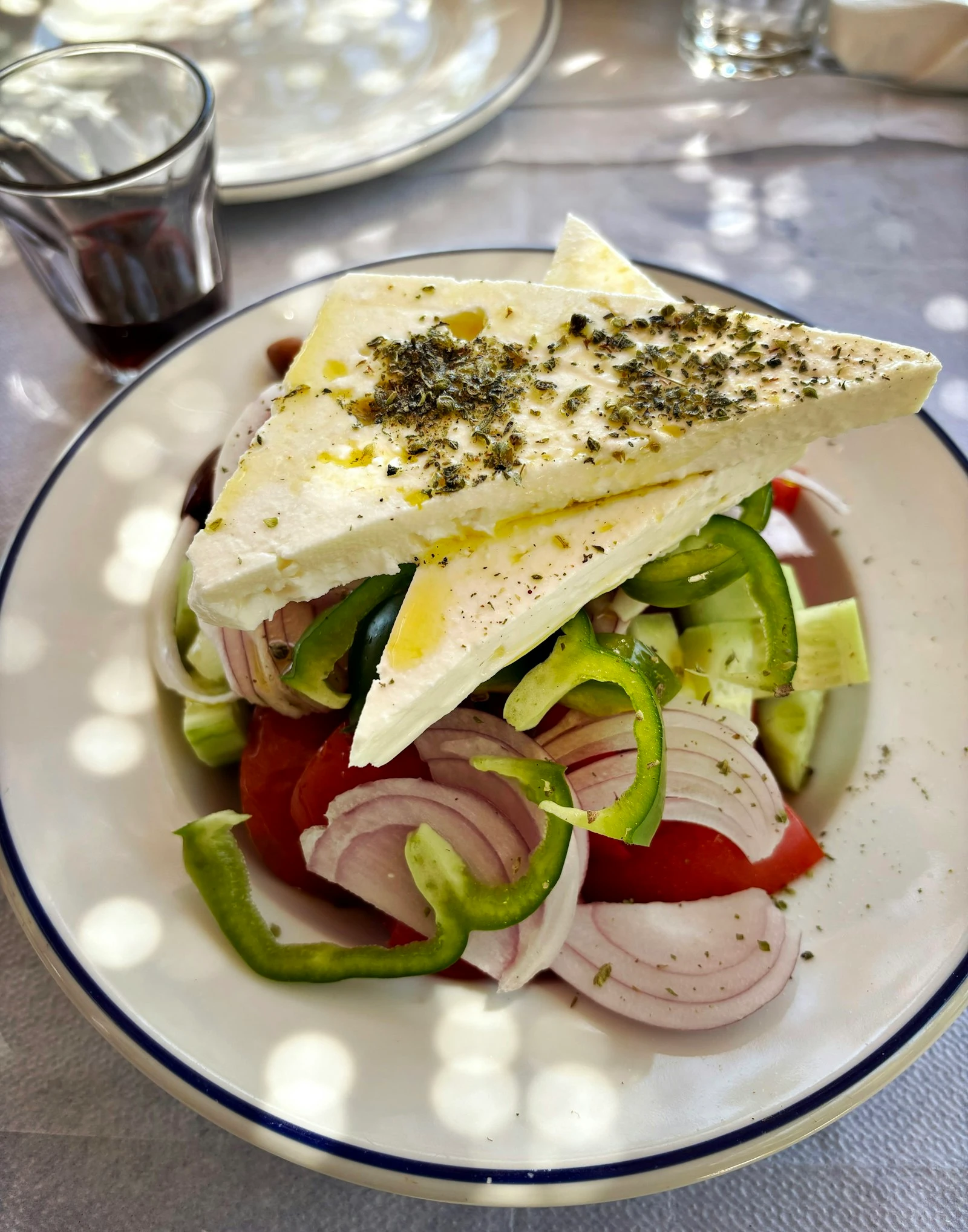
Much of this is already on the Greek table. A Greek salad with feta, chargrilled fish with boiled greens, bifteki (Greek-style burger patties) with a big salad, a spinach omelette: they fit into keto almost as they are. What changes is mostly what comes with them, namely the bread, the potatoes and the rice.
Among fruit it is mainly berries that fit, in small amounts. Nuts call for some restraint, because one handful easily turns into two (almonds reach 9 grams per 100).
Each category in the database also has its own list, sorted from the fewest net carbs to the most: Vegetables, Fruit, Meat and poultry, Fish and seafood, Eggs and dairy.
What you leave out
With 20 to 50 grams for the whole day, starchy and sugary foods have no room: often a single portion uses up the limit on its own.
For the Greek table the biggest sacrifice is pulses. Lentils, beans and chickpeas bring fibre and protein, yet a plate of boiled chickpeas comes close to 50 grams on its own. The same goes for ladera (vegetables slow-cooked in olive oil) with potato, for savoury pies and for sweets.
Some sources are less obvious. Juices and soft drinks are little more than sugar, and ready-made sauces and dressings often hide some too. Beer has quite a few carbs as well: a 330 ml bottle comes to about 12 grams.
A day on the plate
An example with dishes you can make in any Greek home:
Meal | What you eat |
|---|---|
Breakfast | A two-egg omelette with spinach and a little feta, cooked in olive oil |
Lunch | Grilled sardines or salmon with boiled courgettes and broccoli, olive oil and lemon |
Dinner | Bifteki without bread in the mix, with a tomato and cucumber salad and a little tzatziki |
If you get hungry in between | A small handful of walnuts, or strained yogurt with a few blackberries |
The day comes to about 30 grams of net carbs, depending on portions. Most of them come from the tomato, the yogurt and the vegetables; the meat and fish add almost nothing. To go lower, cut those three portions back first.
The first days and “keto flu”
In the first days quite a few people do not feel well: headache, tiredness, dizziness, nausea, constipation and a kind of brain fog are the most common complaints. The whole thing has been named “keto flu”, although it has nothing to do with the flu.
The sudden change is to blame. Your body is getting used to a new fuel and in the first days it loses water and salts.
An Australian study looked at what 300 people wrote about keto on online forums. About one in three described symptoms like these, mostly in the first week; after the first month the complaints had almost stopped. It is a small study, built on posts, but it gives a fair idea of what to expect.
Most symptoms ease with enough water and enough electrolytes (sodium, potassium, magnesium). If you have high blood pressure or a kidney problem, ask your doctor before you add more salt. The Keto flu checklist and the Electrolyte calculator can also help.
If the symptoms are severe or do not ease within a few weeks, talk to a doctor; the same if you have palpitations, marked weakness or feel you are about to faint. In rare cases the complaints of the first days have put people in hospital, with dehydration or a drop in blood sugar.
What the research says
For weight loss keto works, at least in the first few months. Most studies find weight loss and better blood sugar and blood pressure; they have few participants, though, and rarely last more than three months. Those that compare keto with other diets at one year find no real difference.
In 2023 a large review in the journal BMC Medicine looked at 68 clinical trials together. The most certain results were lower triglycerides and fewer seizures in epilepsy; weight loss and lower glycated haemoglobin (HbA1c, the marker of blood sugar over the last three months) came with moderate certainty. Just as certain as the triglycerides, though, was something less welcome: a rise in LDL, the “bad” cholesterol. The trials lasted about 13 weeks, so what this means for the heart in the long run is not yet known.
For cholesterol, the type of fat is what counts. Olive oil, avocado, nuts and oily fish are low in saturated fat; butter, cream and processed meats are high in it. If you plan to stay on keto for more than a few weeks, get blood tests before you start and again after a few months.
For long-term use the evidence is thin. The concerns raised most often are kidney stones, uric acid, and vitamin and mineral deficiencies when the diet lacks variety. An analysis of 36 studies, mostly of children on the ketogenic diet for epilepsy, found a kidney stone in about 6 in 100, with an average follow-up of almost four years.
The best-documented medical use of keto is still epilepsy that medication does not control, mainly in children. There a much stricter form is used, with weighed meals and close supervision by a doctor and a dietitian.
Who should talk to a doctor first
Most healthy adults get through the first weeks without serious problems. In some cases, though, keto starts only with a doctor, or not at all.
Situation | What applies |
|---|---|
Diabetes treated with insulin or tablets that lower blood sugar | With carbs cut, the same dose can push your blood sugar dangerously low. Your doctor adjusts the doses before you start. |
Diabetes treated with SGLT2 inhibitors, such as dapagliflozin or empagliflozin | Together with keto they greatly increase the risk of ketoacidosis, which here can appear even with almost normal blood sugar. In this case keto is avoided. |
Pregnancy | Not recommended, because it has not been shown to be safe for the baby. For breastfeeding, decide together with your doctor. |
A history of eating disorders | The strict rules and the fast change in weight can bring the problem back. |
Pancreatitis, liver failure and rare metabolic disorders, such as disorders of fat metabolism and the porphyrias | Keto is ruled out. |
Kidney stones or kidney disease, high cholesterol or heart disease | Your doctor weighs the pros and cons and decides which tests you will need. |
Children and teenagers | Only with a doctor and a dietitian, because keto can affect growth. |
The same applies if you take medication for a long-term condition: before you change your diet radically, talk it over with the doctor who follows you.
Keto, low carb and high-protein: the differences
The three terms often get mixed up. The rules differ from plan to plan, but broadly the picture is this:
Carbs per day | Protein | Fat | Ketosis | |
|---|---|---|---|---|
Keto | 20 to 50 g | moderate | provides most of the calories | yes, it is the goal |
Low carb | about 50 to 150 g | normal or higher | higher | usually not |
High-protein | low | high | low or moderate | not necessarily |
So keto is not a high-protein diet, since it is high in fat with moderate protein. High-protein diets, such as the Dukan diet, which also caught on in Greece, do the reverse: lots of protein, restrained fat.
If you are looking for foods high in protein, on keto or not, the Most protein list ranks them along with their net carbs. It also has separate lists for meat, fish, eggs and dairy, nuts, pulses and plant-based alternatives.
Frequently asked questions
How many days does it take to get into ketosis?
Usually three to four days on very few carbs, as long as it takes for the glucose stores to empty. For some people it takes a little longer.
Can you eat fruit on keto?
A little. Blackberries have 4.3 grams of net carbs per 100 and strawberries 5.7, so a small portion fits; bananas and grapes do not. All fruit, in order, is in Fruit on keto.
Can I do keto if I do not eat meat?
Yes, though it is harder. Your protein will come from eggs, cheese, yogurt, nuts and plant-based alternatives such as tofu, while pulses fit only in small amounts.
Do I need to measure ketones?
Not necessarily. If you stay consistently below 20 to 50 grams a day, you are most likely in ketosis. For anyone who wants to see it in numbers, there are urine strips and blood meters.
How long can I stay on keto?
Nobody knows for sure, because studies rarely go beyond one year. Many people do it for a few months and then move to a looser low-carb way of eating. For a longer stretch, do it with a doctor or dietitian and regular blood tests.
Sources
- StatPearls: The Ketogenic Diet: Clinical Applications, Evidence-based Indications, and Implementation — Mechanism and the 20–50 g limits, ketosis and ketoacidosis, keto flu, who should avoid keto.
- StatPearls: Low-Carbohydrate Diet — The limits for low carb and keto.
- Harvard T.H. Chan School of Public Health, The Nutrition Source: Diet Review: Ketogenic Diet for Weight Loss — How ketosis starts, moderate protein, weight loss at one year, choice of fats.
- Patikorn et al., BMC Medicine 2023: Effects of ketogenic diet on health outcomes: an umbrella review of meta-analyses of randomized clinical trials
- Bostock et al., Frontiers in Nutrition 2020: Consumer Reports of “Keto Flu” Associated With the Ketogenic Diet
- Acharya et al., Diseases 2021: Incidence and Characteristics of Kidney Stones in Patients on Ketogenic Diet
- Regulation (EU) No 1169/2011 — Annex I: the definition of “carbohydrate” on labels.
- Ola Keto food database — all the food figures, net carbs per 100 g.
About the author
The Ola Keto team
Texts signed “The Ola Keto team” are written and edited by the people who build the site.

Comments
Comments are members’ personal views and experiences and are not medical advice. Do not change medication or treatment without your doctor.
To comment, sign in or create an account.
No comments yet. Write the first one.